| THE SEAL MATRIX |
CATALOGUE 4
|
| THE SEAL MATRIX |
CATALOGUE 4
|
A type of seal matrix only briefly mentioned so far is the signet or seal ring worn on the finger. On these the device and legend are engraved into the metal of the bezel or an engraved stone or gem (intaglio) is inset into it. The ring could then be used as with all seal matrices to make an impression in wax to authenticate and seal a letter or document. Classical as well as Medieval imitation intaglios were much prized in the Middle Ages and many were mounted for use in finger rings and seals. Of course these were used by the higher orders of society and set in rings of gold and silver so lucky indeed will be the person that finds such a seal. More frequently used, particularly in the later period from the 14th century onwards, are seal rings with the bezel engraved directly. Quite a few have survived down to the present time enabling us to identify the different styles. Gold silver and bronze are all used and although the number of devices are not so prolific as on the ordinary seal matrices nevertheless there are a considerable variety including heraldic arms and badges, merchants marks, rebuses and initials.
Perhaps the most common seal rings are the bronze examples illustrated above which date from the 15th and early-16th century. The device on these rings is a letter or letters, usually crowned, and these represent the wearer's name. The belief once widely held that the initials represent Saints names is now discounted with the discovery of documents in which the Christian name tallies with that on the seal. The example (above; right) is however a religious one having as its device the sacred monogram IHC which represents the first three letters of the Greek word for Christ - IHCOYC. These rings are also known in silver but examples in gold as with most artefacts are exceedingly rare.
Much of what has already been said about heraldry also holds true for these seal rings, but it may be added that in the 15th century a badge and motto was frequently used in place of the Coat of Arms. Merchants marks first appear in the 14th century and are a commonly used device on these seal rings. Used by merchants and craftsmen not entitled to bear Arms, these marks remain enigmatic unless on some rare occasions a name also appears around the band. As with ordinary seal matrices devices relating to the name of the owner or his occupation were very popular in the 15th and 16th centuries.
|
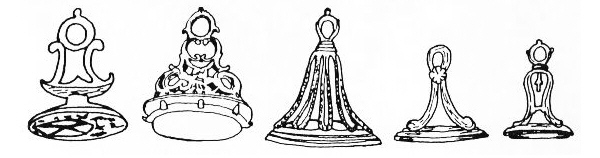
Mention has already been made earlier of the small pendant seals which came back into fashion in the 17th century, although from this period onwards they are termed 'fob seals'. This name derived from the fashion of attaching them to a watch-chain or ribbon which was carried in the 'fob' (pocket) originally in the breeches waist-band. Fob seals enjoyed a wide appeal as a fashion accessory from this time until the 1830's, their height of popularity being in the Georgian period. Advertisements in contemporary newspapers illustrate the fashion:-
|
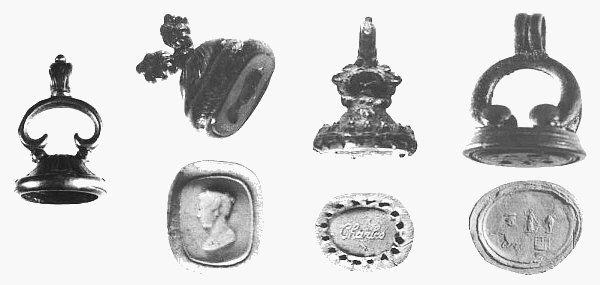
An unusual type of fob seal dating to the late-17th and early-18th centuries has three engraved faces, usually heraldic, on a triangular matrix which is set to swivel within an openwork handle (above; left). The face of the die required for sealing is held into position by a clip actuated by a spring and screw. Swivel seals are more commonly found with a double matrix as the example illustrated (above; centre). Yet another type has multi-arm seals with a different die on each face (above; right). These are believed to date from the 17th century and the quality of engraving is usually poor and the devices generally non-heraldic.
|
As with the seals of earlier times the fob-seal may be engraved directly into the metal or set with an intaglio gem although generally the inset intaglio is preferred from the mid-18th century onwards. Although engraved precious gems mounted in gold and silver may be used for the better quality fob-seals of the rich, the lower classes had to be content with a variety of mineral hardstones or semi-precious gems set in brass mounts which could be silvered or gilded to imitate the more costly materials (see examples above). In those illustrated below the fob-seals have become mere decorations, the stones unengraved but made so as to swivel in their mounts.
|
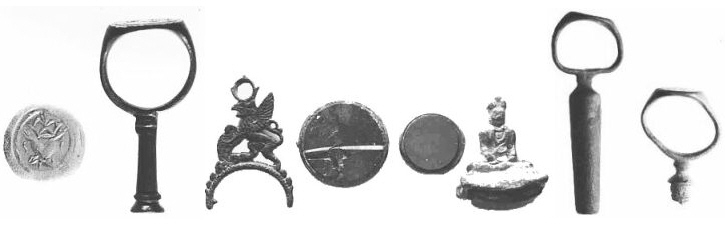
Finally a brief look at artefacts designed specifically for another purpose but which may also include a seal matrix. Pipe tampers for tamping down the tobacco in clay pipes were used extensively from the 17th century until the mid-19th century. Many decorative examples are known, but one type in particular of the mid-17th to mid-18th century has a ring attached to one end of the tamper (above; left). These are frequently engraved for use as a seal. Brass pocket corkscrews (above; right) date to the late-18th century. The steel corkscrew is protected by a sheath which is threaded and screws onto the signet-ring shaped terminal. The end of the sheath may have doubled as a pipe tamper and the ring as a seal - an early example therefore of a multi-purpose device.